
History & Heritage of English Martyrs Walworth - 14 Sep 2026
The story of English Martyrs Catholic Church is a story of faith, community and continuity.
For generations, Catholics in Walworth have gathered to worship, celebrate the sacraments and build a community around their faith. The present church is part of that longer story, carrying the name and identity of English Martyrs while continuing to serve the people of Walworth today.
From the earliest Catholic worship in the area to the development of purpose-built churches, schools and parish buildings, the history of English Martyrs reflects the growth of Catholic life in South London.
Today, the church remains a place of prayer, worship and community, connecting the present parish with the generations who came before.
The Beginnings of Catholic Worship in Walworth
The roots of the English Martyrs community go back to the nineteenth century.
Historical records show that the first congregation began meeting in 1881 in a room at St Mary’s Court, off Blossom Street. By 1889, the congregation had moved to the upper floor of a school building at 17 Blossom Street, where Catholic worship continued while plans for a permanent church developed.
Another account of the parish records a Catholic primary school being established in the area in 1890, with the school being used for services while a purpose-built church was planned.
These early arrangements reveal an important part of the parish’s history: the Catholic community existed before it had the church building that people would later associate with English Martyrs.
The parish was growing, and the need for a permanent place of worship became increasingly important.
Building a Catholic Community in Walworth
In 1893, a nearby site was acquired for a church dedicated to the English Martyrs.
According to the Catholic heritage survey Taking Stock, the proposed church was intended to serve a working-class congregation that was predominantly Irish, with some Italian families. Fundraising included significant support from the Guild of Our Lady of Ransom.
The development was about more than constructing a building. It reflected the growth of a Catholic community in Walworth and the desire to establish a permanent place where people could worship, educate their children and live out their faith together.
A presbytery was built in 1895, and plans for a church developed over the following years. The foundation stone of the earlier purpose-built church was laid in February 1902, and the church opened in 1903, according to Taking Stock.
This period marked an important stage in the development of Catholic life in Walworth, as the growing congregation established a more permanent presence in the local community.
Why Is It Called English Martyrs?
The name of the parish connects the church with the history of Catholics who suffered persecution and death for their faith during the Reformation and its aftermath.
The dedication of the Walworth church also has a particularly local connection. The Catholic heritage record explains that the English Martyrs commemorated here were associated with Catholics executed at the North Surrey Gallows, which was nearby.
The name therefore connects the parish to both the wider history of Catholic England and the history of the local area.
Inside the church, this heritage has also been represented through religious artwork, including large polychrome statues of martyrs.
The memory of the martyrs is not simply part of the church’s name. It forms part of the spiritual identity and heritage of the parish.
The Church Building We See Today
The history of English Martyrs includes more than one phase of church development.
The Catholic community in Walworth predates the present church building. Historic England records the present Roman Catholic Church of the English Martyrs and attached presbytery as dating from 1931–32, designed by Williams and Jopling of Hull in an Early Christian style.
The church was built at a cost of approximately £12,000 and was designed to accommodate around 520 people.
This distinction is important when telling the history of English Martyrs. The Catholic community did not begin with the present building. Rather, the current church represents one stage in a much longer story of Catholic worship and community life in Walworth.
A Church With Its Own Character
English Martyrs is also significant as a piece of local architecture.
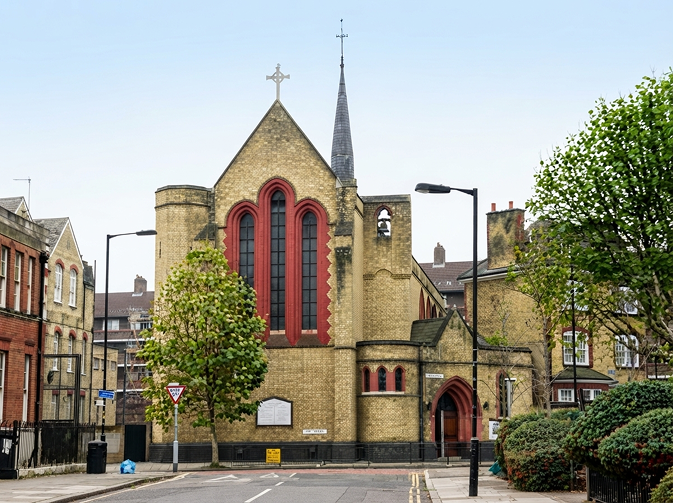
The church occupies a prominent position at the junction of Rodney Road and Flint Street and forms part of a wider group with the adjoining presbytery and school. A Southwark conservation-area appraisal describes the church as a prominent landmark along both Rodney Road and Flint Street.
Its architectural character includes yellow brick, contrasting brick details, pitched slate roofing and a distinctive slender spirelet. The church also features pointed-arch openings, lancet windows, buttressed elevations and a Lady Chapel facing the Rodney Road junction.
These features give English Martyrs a distinctive presence within the streetscape of Walworth.
The building is therefore important not only as a place of worship, but also as part of the architectural and social history of the local area.
A Grade II Listed Church
The church and its associated buildings are recognised for their architectural and historical significance.
The Roman Catholic Church of the English Martyrs and attached presbytery is Grade II listed on the National Heritage List for England. Historic England’s listing recognises the architectural and historical importance of the building.
The presbytery is also separately recognised as a Grade II listed building.
The church’s listed status means that its architectural character is not simply part of its past. It is part of the heritage that continues to be preserved today.
A Church That Has Changed With Its Community
Historic churches do not remain completely unchanged.
English Martyrs has undergone changes to its interior and worship space as Catholic liturgy and parish life developed. Historic England records a significant sanctuary reordering in 1967, when the high altar, altar rails and pulpit were removed and a new forward altar was introduced.
These changes are part of the building’s living history.
The church has continued to adapt while remaining a place of Catholic worship. Its history is therefore not simply about preserving an old building. It is also about how generations of Catholics have continued to use, worship in and care for it.
More Than a Church Building
The story of English Martyrs extends beyond the walls of the church.
A Catholic school was established in the area as the community developed, and the church, presbytery and school became part of a wider Catholic presence in Walworth. Taking Stock records the development of the school and church as part of the parish’s early growth.
That connection between worship, education and community remains an important part of understanding English Martyrs.
The parish continues its Catholic life in Walworth, while English Martyrs Catholic Primary School carries the name and Catholic identity into the life of the local community.
From the First Congregation to Today
The story of English Martyrs can be understood as a story of generations.
People first gathered for Catholic worship in modest surroundings. The community grew. Schools and church buildings followed. New generations inherited the faith, adapted parish life to changing circumstances and continued to gather for Mass and the sacraments.
The buildings have changed.
The community has changed.
Walworth itself has changed.
But the parish continues to provide a place where people can worship, pray, celebrate the sacraments and find community.
That continuity is one of the most important parts of the heritage of English Martyrs.
Preserving the Story
The heritage of English Martyrs is preserved not only through its listed buildings but also through the memories, records, photographs and stories of the people who have been part of the parish.
Historic documents and Catholic heritage research provide valuable insight into the development of the church and community.
The parish itself has also been the subject of historical work, including a publication titled English Martyrs, Walworth 1890–1990: A Brief History, published by English Martyrs in 1990.
Preserving these records and stories helps future generations understand where the community has come from and how the parish has developed over time.
The photographs, memories and experiences of parishioners are an important part of this continuing heritage.
English Martyrs Today
Today, English Martyrs remains a Roman Catholic parish serving Walworth and the surrounding community.
The church continues to be a place for Mass, prayer, the sacraments and parish life. Its historic buildings provide a visible reminder of the generations of Catholics who have worshipped in this part of South London.
The story of English Martyrs is therefore still being written.
Every Mass celebrated, every sacrament received, every prayer offered and every person welcomed into the community becomes part of the continuing life of the parish.
The history of English Martyrs is not simply a story about the past. It is also the story of a Catholic community that continues to live, worship and serve in Walworth today.